


There are certain foods that seem to announce the arrival of a new season in Portugal. In summer, it is impossible to imagine a day at the beach without a cold drink, a gelado or a traditional bola de Berlim. But when autumn arrives, our food traditions change with the weather.
In Portugal, we go from eating bolas de Berlim at the beach to eating roasted chestnuts in the streets.
Suddenly, the smell of charcoal and roasted chestnuts begins to fill the streets of Lisbon, Porto and cities and towns across the country. You see the familiar metal chestnut roasters appearing on pavements, surrounded by white smoke. You might hear the traditional call of “Quentes e boas!”, meaning “Hot and good!”, and before long you are holding a paper cone filled with steaming castanhas assadas.
For many Portuguese people, this is one of the unmistakable signs that autumn has arrived.
And while eating roasted chestnuts might seem like a simple snack, in Portugal it is much more than that. It is connected to childhood memories, family traditions, São Martinho, changing seasons and the atmosphere of Portuguese streets.
Castanhas assadas: the taste of Portuguese autumn
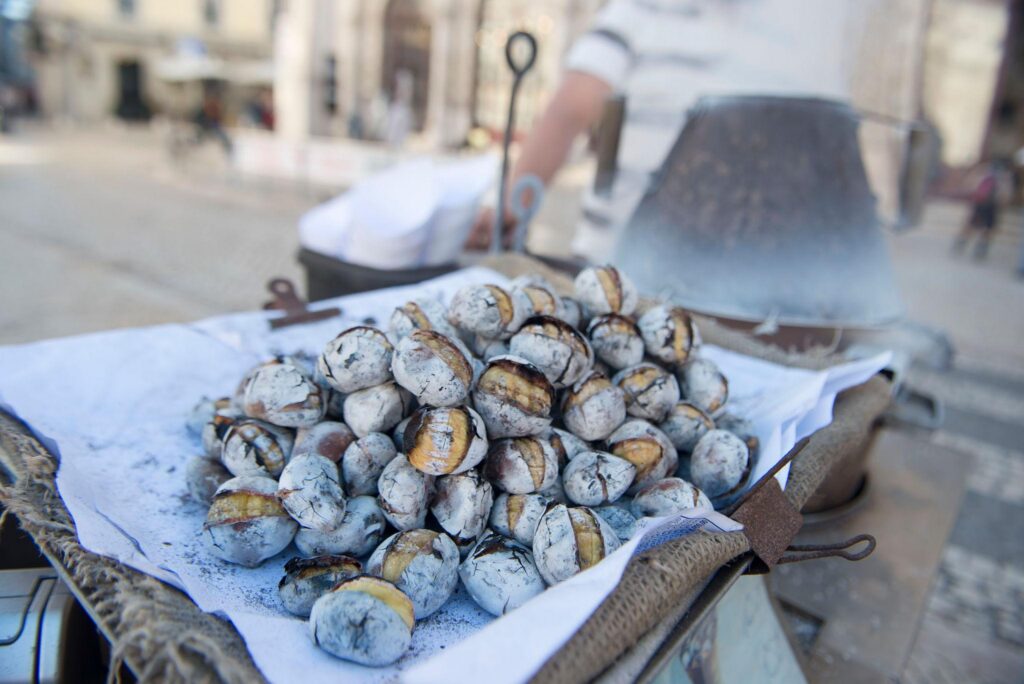
Roasted chestnuts have been eaten in Portugal for centuries. The traditional Portuguese preparation is wonderfully simple. The chestnuts are cut across the shell so they do not burst during roasting and are then cooked over hot charcoal.
As they roast, the shells become dark and crispy while the inside becomes soft, warm and slightly sweet. Salt is often added, creating that familiar combination of smoky, sweet and salty flavours.
The traditional method is part of what makes the experience so special. Portuguese agricultural authorities describe the chestnuts as being roasted over charcoal until the skin becomes crisp and the flesh tender. After roasting, they can be salted and kept covered for a while, which helps make them softer and more flavourful.
But the food is only part of the experience.
The smell is just as important.
You can be walking through a busy city street, thinking about something completely unrelated, when suddenly you smell roasted chestnuts. You follow the smoke and there is the chestnut seller, standing beside a traditional roaster, turning and preparing the chestnuts for the next customer.
It is one of those smells that immediately makes Portugal feel like autumn.
From the beach to the streets
One of the things that makes this tradition particularly Portuguese is how strongly it marks the change between seasons.
During the warmer months, Portuguese life revolves around the coast. We spend our days at the beach, swimming in the Atlantic, sitting on the sand and enjoying one of Portugal’s most iconic summer treats: the bola de Berlim.
You can walk along a Portuguese beach in August and almost guarantee that at some point you will hear someone asking:
“Queres uma bola?”
Then autumn arrives.
The beach bags disappear, the evenings become cooler and the smell of roasted chestnuts starts replacing the smell of sunscreen and sea salt.
It is almost as though Portugal has its own seasonal street-food calendar.
Summer means bolas de Berlim at the beach. Autumn means castanhas assadas in the streets.
And just as the bola de Berlim is connected to memories of Portuguese summers, roasted chestnuts are deeply connected to autumn.
Buying roasted chestnuts on the streets of Lisbon
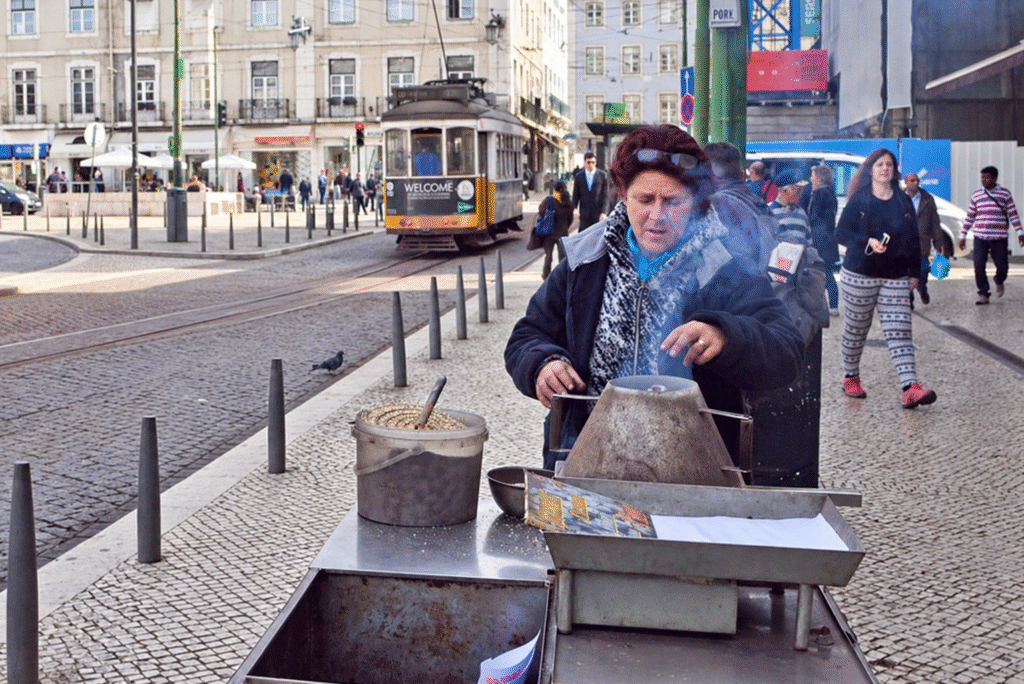
If you visit Lisbon during autumn, one of the easiest ways to experience this tradition is simply to walk around the city and look for the smoke.
Chestnut sellers can traditionally be found in busy areas of central Lisbon, particularly around places such as Rossio, Baixa, Chiado, Avenida da Liberdade and other popular pedestrian areas.
You do not need to visit a restaurant or make a reservation. You simply approach the seller and ask for your chestnuts.
Traditionally, they are sold by the dozen, although portions can vary. In recent years, sellers in Lisbon have commonly offered a dozen chestnuts in a paper cone, with prices varying depending on the location and season.
The experience is wonderfully informal.
You hand over your money, receive your warm paper cone and immediately begin peeling the chestnuts while they are still hot. Your fingers get a little messy, the shells pile up and you inevitably discover that some chestnuts are easier to peel than others.
That is all part of it.
There is something particularly satisfying about walking through Lisbon with a warm cone of chestnuts in your hands on a cool autumn afternoon.
Some of the best areas to look for roasted chestnuts in and around Lisbon include:
- Rua Augusta, near Rua de Santa Justa
- Rua Garrett, near Bertrand Bookstore
- Praça dos Restauradores, near the Glória Funicular
- Rua do Carmo
- Largo do Chiado, near A Brasileira
- Avenida da Liberdade, near Teatro Tivoli
- Praça Duque de Saldanha
- Cais do Sodré, near the Metro
- Avenida Almirante Reis, near Anjos Metro
- Jardim da Estrela, at the main entrance
- Santa Apolónia
- Amoreiras, near the shopping centre
- Oeiras, near the train station
The best part? You can combine your chestnut hunt with sightseeing. Pick up a dozen castanhas assadas, peel them as you wander through Lisbon, and enjoy one of the city’s simplest and most delicious autumn rituals.
The old newspaper tradition
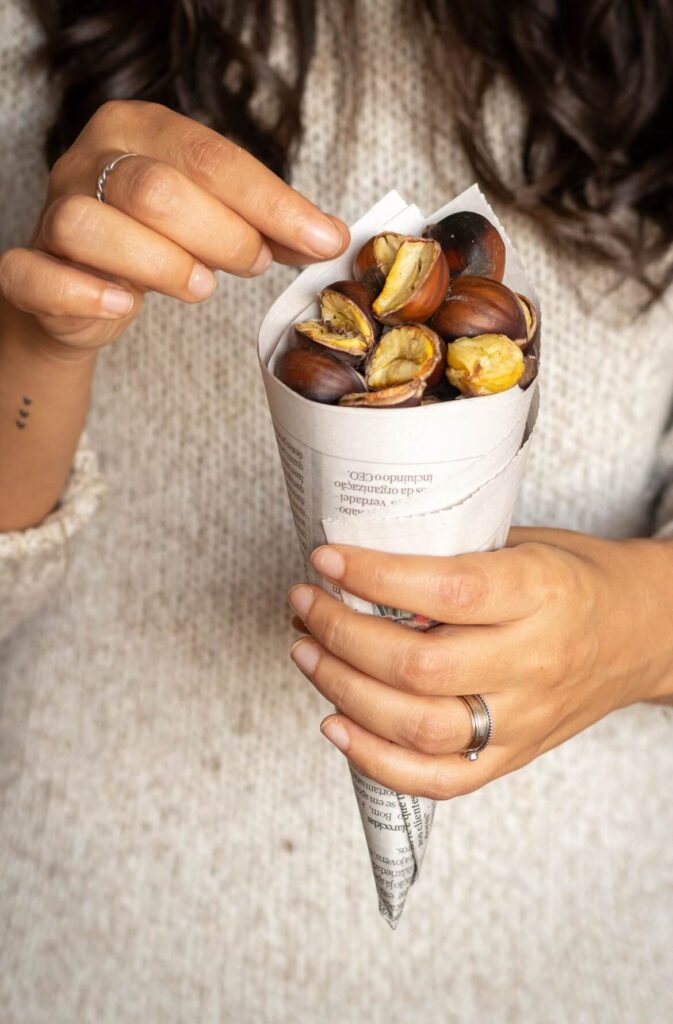
For older generations of Portuguese people, there is another detail that makes roasted chestnuts especially nostalgic: the newspaper cone.
Back in the day, chestnut sellers commonly served their chestnuts wrapped in a sheet of newspaper. The seller would take the newspaper, fold it into a cone and fill it with hot roasted chestnuts.
The tradition was so familiar that the newspaper itself became part of the experience.
Some sellers also used pages from old telephone directories, particularly the famous yellow pages. Portuguese agricultural authorities specifically record that chestnuts were traditionally sold in paper cones, formerly made from newspapers or telephone directories.
For someone who grew up with this tradition, the image is instantly recognisable: a street vendor beside a smoking roaster, a dozen hot chestnuts wrapped in a piece of newspaper and the smell of charcoal following you down the street.
Nowadays, things are different.
Food-safety rules mean that vendors use clean, food-safe paper rather than old newspapers. The traditional newspaper wrapping has largely disappeared, although some modern paper cones may still have a design that evokes the old style.
The tradition has changed, but the ritual has survived.
And the way we buy them has remained remarkably familiar too. You can still ask for half a dozen or a dozen, depending on how many you want.
Chestnuts in Porto
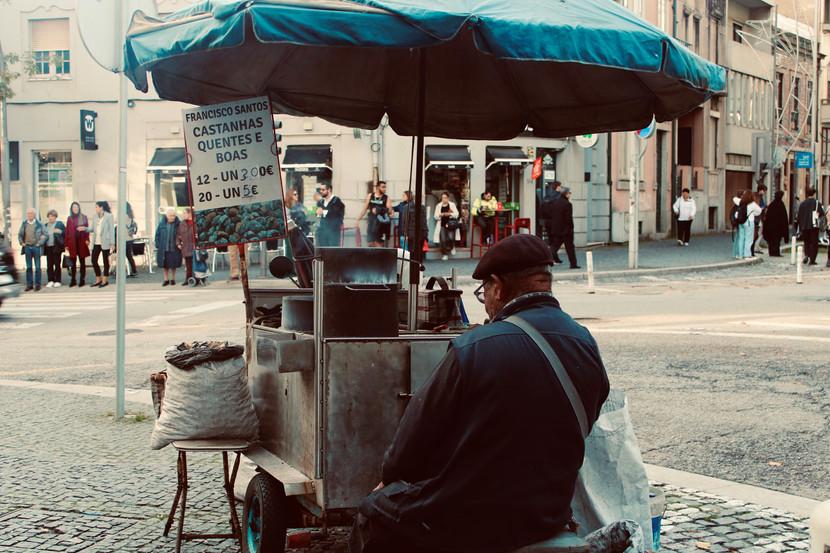
Lisbon is not the only Portuguese city where autumn smells like roasted chestnuts.
In Porto, the tradition is just as much a part of the city’s autumn atmosphere.
As the weather cools, chestnut sellers appear in different parts of the city, including busy areas such as Rua de Santa Catarina, Trindade, Boavista and around the historic centre. Sellers can also be found in areas such as Foz.
Walking through Porto with a paper cone of chestnuts is particularly atmospheric. The city’s steep streets, old buildings and grey autumn skies seem almost made for this kind of food.
Around São Martinho, the smell of chestnuts becomes even more noticeable.
In fact, Porto has a particularly strong connection with the tradition. The city’s municipal cultural publication has highlighted families who have been selling roasted chestnuts for decades, passing the knowledge of roasting from one generation to another.
For many vendors, this is not simply a seasonal business. It is a family tradition.
Some of the best areas to look for roasted chestnuts in Porto include:
- Rua de Santa Catarina
- Trindade Metro Station
- Boavista, around Casa da Música and Rotunda da Boavista
- Torre dos Clérigos
- São Bento
- Bolhão
- Praça do Império, in Foz
- Jardim do Passeio Alegre
- Castelo do Queijo
- Cais da Ribeira
One of the nicest things about buying chestnuts in Porto is that you don’t really need to plan it. Follow the smoke and look for the traditional chestnut cart. When you see the charcoal glowing and hear someone calling “Quentes e boas!”, you know you’ve found them

São Martinho and the tradition of the magusto
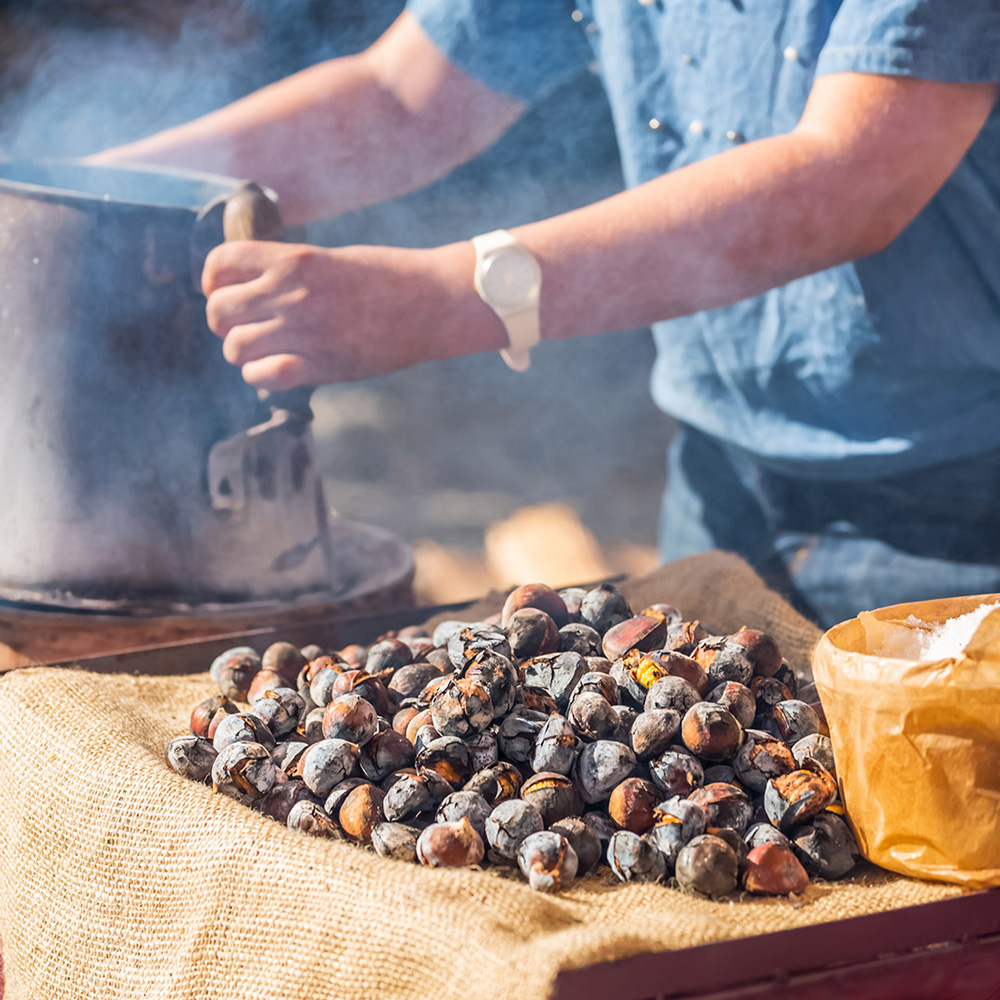
Although roasted chestnuts are eaten throughout autumn, the tradition is particularly associated with São Martinho, or Saint Martin’s Day, celebrated on 11 November.
This is one of Portugal’s most beloved autumn traditions.
The celebrations are known as magustos, gatherings where people come together to eat roasted chestnuts and traditionally drink água-pé, jeropiga or new wine. The tradition is particularly strong in northern Portugal, although São Martinho is celebrated throughout the country.
There is also a famous Portuguese legend associated with São Martinho.
According to the story, Saint Martin was travelling on a cold, rainy day when he came across a beggar who was freezing. Martin cut his cloak in half with his sword and gave half to the man.
As a reward for his kindness, the rain stopped and the sun appeared.
This is said to explain the tradition of the “Verão de São Martinho”, or Saint Martin’s Summer, when Portugal sometimes experiences a few unexpectedly warm and sunny days around November.
And naturally, no São Martinho celebration would be complete without chestnuts.
The Portuguese saying captures the tradition perfectly:
“Pelo São Martinho, castanhas, pão e vinho.”
Chestnuts, bread and wine are closely connected with this time of year.
More than a snack
One of the reasons the chestnut tradition has survived for so long is that it is about much more than food.
Roasted chestnuts are connected to people and places.
They remind Portuguese people of walking home from school on a cold afternoon, stopping with friends to buy a cone. They remind older generations of newspaper-wrapped chestnuts. They remind families of São Martinho gatherings, bonfires and glasses of new wine.
And for visitors to Portugal, they offer a very simple way to experience local culture.
You do not need to visit an expensive restaurant or book a special activity. Simply walk through Lisbon or Porto in autumn, find a chestnut seller and buy a few.
The experience is part of Portuguese street life.

Where do Portuguese chestnuts come from?
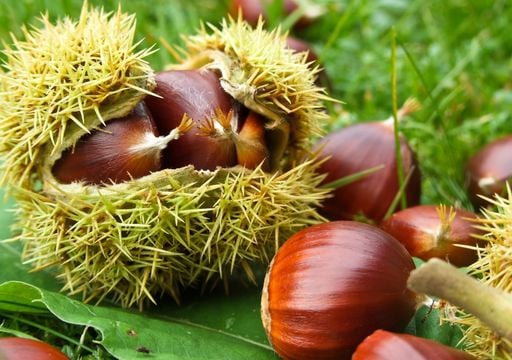
Although you will see chestnut sellers in cities all over Portugal, some of the country’s most important chestnut-growing areas are in the north and northeast.
Trás-os-Montes is particularly famous for its chestnuts and is sometimes associated with the expression “ouro transmontano”, or the gold of Trás-os-Montes. The quality of the chestnut matters enormously to the final result, and good chestnuts should be full, firm and have a good size.
The chestnut is therefore not simply a city street snack. It connects Portugal’s rural landscapes with its urban streets.
The chestnuts grown in the countryside eventually appear in the hands of people walking through Lisbon, Porto and other Portuguese cities.
The simple pleasure of eating them
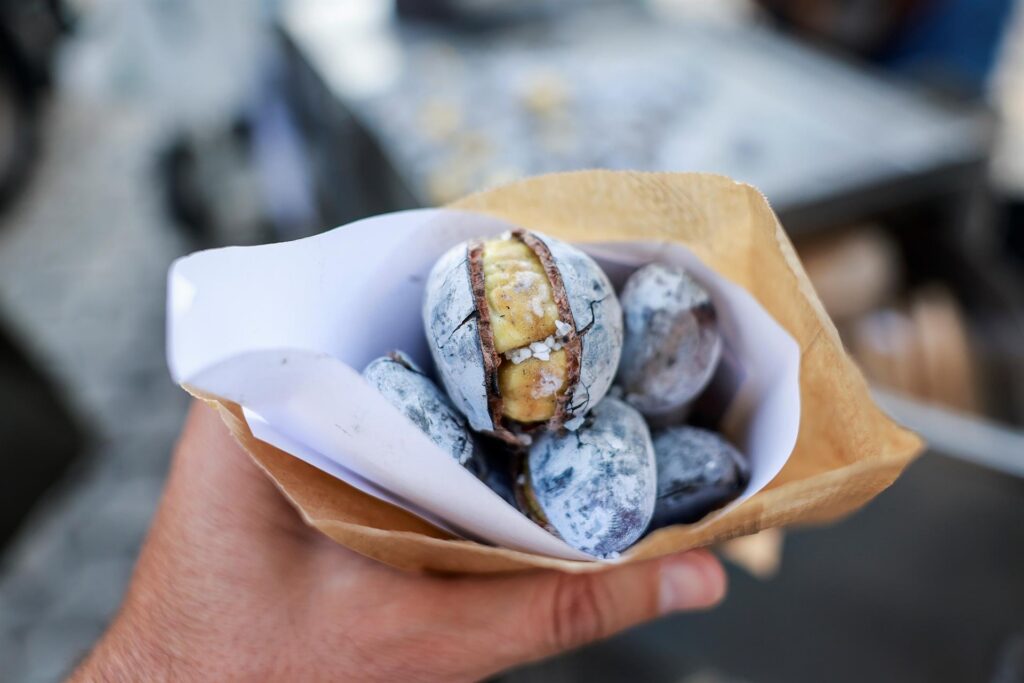
There is no complicated way to eat a roasted chestnut.
You take one from the cone, peel away the blackened shell and eat the warm flesh inside.
Sometimes it comes away perfectly.
Sometimes the shell sticks.
Sometimes you burn your fingers because you were too impatient to wait.
And sometimes you eat one that is so sweet and soft that you immediately reach for another.
That simplicity is part of the charm.
Portuguese roasted chestnuts are not designed to be sophisticated. They are designed to be warm, comforting and shared.
They are the kind of food you eat while walking, chatting with someone, watching the smoke rise from the roaster or simply enjoying the feeling of autumn arriving.
An autumn tradition that refuses to disappear
Portugal has changed considerably over the generations, and the way we eat chestnuts has changed too.
The old newspaper cones have largely disappeared. The traditional street vendors now use food-safe paper. Modern city life looks very different from the Portugal of decades ago.
But the chestnut sellers are still there.
The charcoal still burns.
The smoke still rises into the streets.
The chestnuts are still sold in small portions, traditionally by the half dozen or dozen, and people still stop to buy them.
And perhaps that is what makes the tradition so special.
Every autumn, Portugal goes through a small seasonal transformation. The beach towels are put away, the days become shorter, and the smell of roasted chestnuts begins drifting through the streets.
In Lisbon, you might encounter it while walking through Baixa or Chiado. In Porto, you might smell it while exploring the historic centre or walking down Rua de Santa Catarina.
And suddenly you know:
Autumn has arrived in Portugal.
The summer bolas de Berlim have been replaced by castanhas assadas.
The beach has been replaced by the city streets.
And instead of holding a sweet treat while sitting in the sunshine beside the Atlantic, you are walking through the crisp autumn air with a warm paper cone of roasted chestnuts in your hands.
It is a small tradition, but one that says a great deal about Portugal: seasonal, simple, social and deeply connected to memories.
So, if you visit Portugal in autumn, follow the smoke.
Find a chestnut seller.
Ask for half a dozen or a dozen.
Peel them while they are still hot.
And experience one of the simplest and most delicious signs that autumn has arrived in Portugal.